TL;DR
Cavitation (3D Lipo) and fat freezing (cryolipolysis) are both non-surgical treatments aimed at small, defined pockets of fat, but they work in different ways and feel different during a session. Neither is a weight-loss treatment, results vary from person to person and are not guaranteed, and both usually involve a course of sessions. The right choice depends on your area, your goal and your suitability, which is confirmed at an in-person consultation and assessment. This guide compares the two honestly.
If you have been comparing non-surgical body treatments, two names come up repeatedly: cavitation and fat freezing. They are often mentioned in the same breath, which can make it hard to tell them apart or work out which might suit you. Here is a straightforward comparison, without the hype, to help you go into a consultation with better questions.
First, what they have in common
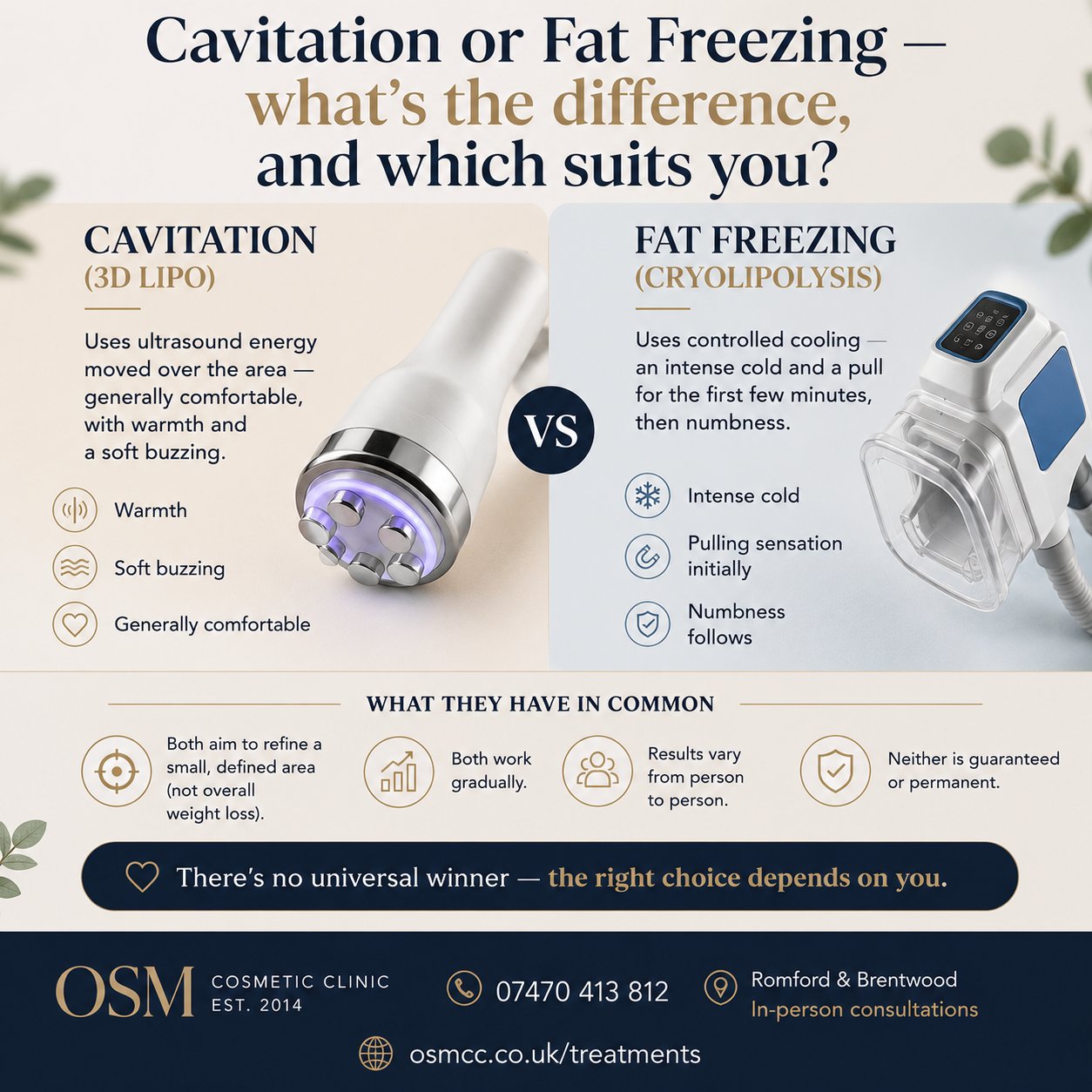
Before the differences, it helps to be clear about what both treatments share, because it matters. Both cavitation and fat freezing are non-surgical and aim to reduce the appearance of small, defined pockets of fat in a specific area, rather than reduce weight overall. Neither is a weight-loss treatment, and neither replaces a balanced diet and regular movement. Both tend to suit people already close to their target weight who would like to refine one particular area. With both, results vary from person to person, appear gradually over the weeks that follow rather than instantly, are not guaranteed or permanent, and are usually delivered as a course of sessions. And with both, maintaining a stable weight helps preserve any change you see.
If that sounds like a lot of caveats, it is deliberate. Honest expectations are the single most useful thing you can bring to this decision.
How cavitation works
Ultrasonic cavitation, often part of a 3D Lipo system, uses low-frequency ultrasound energy applied to the skin's surface over the treated area. The idea is that this energy targets fat in the area so the body can gradually process it over the following weeks.
What a session feels like: cavitation is generally described as comfortable. A handpiece is moved over the area, and you may feel warmth and hear a high-pitched buzzing tone during the treatment. There is usually no numbing required, and most people find it easy to tolerate. Afterwards, you can typically carry on with your day. Mild redness or warmth in the area is common and usually settles quickly. Clinics often advise staying well hydrated and keeping gently active to support your body's natural processes.
How fat freezing works
Fat freezing, known clinically as cryolipolysis, uses controlled cooling instead of ultrasound. The treated area is usually drawn into an applicator and cooled, working on the principle that fat cells are more sensitive to cold than the surrounding skin and tissue.
What a session feels like: most people notice an intense cold and a firm pulling sensation in the first several minutes, which usually eases as the area becomes numb. After that many people find the session quite uneventful and simply relax. A brief massage of the area often follows once the applicator is removed. Afterwards, temporary redness, swelling, tenderness, bruising, firmness or altered sensation in the treated area is common and usually settles over the following days to weeks.
So, does cavitation "work" — and does fat freezing?
This is the honest heart of the matter. Both treatments are widely offered as ways to reduce the appearance of a stubborn pocket of fat, and many people choose to have them. But the outcome genuinely varies between individuals, changes are gradual rather than dramatic, and results depend a great deal on maintaining a stable weight afterwards. Neither should be presented as guaranteed, and you should be cautious of any clinic that promises a fixed or permanent result.
The most reliable way to know whether either is likely to help with your particular concern is an in-person assessment, where a practitioner can look at the specific area and give you an honest view rather than a one-size-fits-all answer.
Which might suit you?
There is no universal winner, and the better question is which suits you. The choice usually comes down to: the area and how it is shaped (some areas lend themselves more naturally to an applicator, others to a handpiece moved across the surface); the sensation you would prefer (some people would rather the warm, buzzing feel of cavitation, others do not mind the initial cold of fat freezing); your suitability (certain medical conditions, medications and circumstances affect which treatments are appropriate, and cold-based treatments in particular are not suitable for everyone); and your goal and expectations, which shape the recommendation and the likely number of sessions.
Sometimes a clinic may suggest one over the other, a combination approach, or neither. Being told a treatment is not right for you is a sign of a genuine assessment.
Who these treatments are not for
Both cavitation and fat freezing are generally not suitable during pregnancy or breastfeeding, for anyone under 18, or for people with certain medical conditions or medications. Fat freezing in particular is not appropriate for some conditions affected by cold. These are not complete lists, which is precisely why suitability is confirmed in person rather than assumed from an online form.
Every treatment starts with a conversation
At OSM Cosmetic Clinic, established in 2014, every treatment begins with an in-person consultation and suitability assessment. We take time to understand your goal for the area, review your history, explain honestly how each option works and whether it suits you, and answer your questions before you decide anything. If neither treatment is right for you, we will say so.
If you would like to explore your options, you can read more about 3D Lipo cavitation and fat freezing, or visit us at our Romford or Brentwood clinics. Consultations are booked with a £30 deposit, which goes towards your treatment. To ask a question first, call 07470 413 812 or email info@osmcc.co.uk.
This article is general information and not a substitute for personal medical advice. If you have health concerns, please speak to your GP or a suitably qualified professional.
Frequently asked questions
Written by OSM Cosmetic Clinic, established 2014, Romford & Brentwood.